
Showing posts with label Miami. Show all posts
Showing posts with label Miami. Show all posts
Wednesday, February 25, 2015


Friday, July 18, 2014
Center Grove Loft! 1BR/1BA+Den! Great Price! Low Maint! IncredibleLocation!
GET TO KNOW THE GROVE
and see why this is the best deal in it!

GROVE SQUARE CONDO
2801 FLORIDA AVE #220
COCONUT GROVE, FL 33133
1 Bedroom
1 Bath
Den
750 Sq Ft - (Largest 1BR Line in Complex)
Just Steps from Swimming Pool
1 Assigned Parking Space - Secure Underground Garage
Racquetball Court
Low Monthly Maintenance - Only $310/ Mo.
UNBELIEVABLE PRICE!
$239,999
Terrific loft style 1BR/1BA+Den condo in the heart of Coconut Grove! Roll out of bed & you're 1 block away from the shopping, bars, restaurant, fun & excitement of Cocowalk! Short walk to Peacock Park and Coconut Grove Marina. Coral Gables, Downtown Miami, Key Biscayne, U-M and Miami Beach are minutes away. Unit features updated kitchen with SS appliances, Breakfast Area Granite Counters and large living-dining area. Largest 1BR line in complex. Amenities include pool and racquetball court.


 |
| Den / Home Office |
 |
| Kitchen |
 |
| Living Room |
 |
| Living Room |
 |
| Dining / Breakfast Area |
 |
| Living/Dining Area Coconut Grove is host to some of South Florida's most extraordinary natural landscapes and world famous annual festivals. All of the following photos are within walking distance of Grove Square Condo! |


Saturday, July 12, 2014
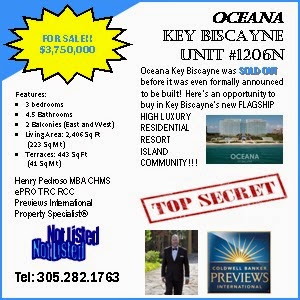
Oceana Key Biscayne New Construction - Pre-Completion Sale of 3BR/4.5BA High Luxury Condo in SOLD OUT Waterfront Development


This luxury waterfront development was SOLD OUT before it ever had a chance to be advertised. You may not get another opportunity to own at Oceana Key Biscayne for a very long time.
3Beds/4.5 Baths/2,406 Sq Ft/2 Balconies
2 Parking Spaces
Offered at
$ 3,750,000
See Video Below for
Array of Amenities and Features
Floor Plan

Amazing Video - Turn Up The Sound!
Call or Email me for more information!
305.282.1763
Wednesday, July 9, 2014
Wealth Daily Report- EB-5 Immigrant Investor Program A Win- Win for Real Estate Developers and International Investors Alike
I've recently blogged about the benefits and advantages of the EB-5 Immigrant Investor Program for foreign nationals seeking permanent residency for themselves and their families.
The following are just a few current real estate development projects that have and are obtaining funding:


Wealth Daily- EB-5 Program, Cash For Green Cards
The following is a report from Fox News on how South Florida is taking advantage of EB-5 to help fuel the current boom in housing and construction.
The following are just a few current real estate development projects that have and are obtaining funding:

Riviera Point Business Center - Doral, FL

Margaritaville Resort - Hollywood Beach, FL
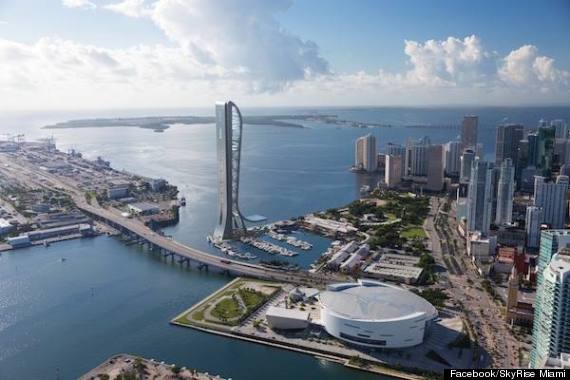
Skyview Observation Tower/Bayside Marketplace
Downtown Miami
There are a number of other projects that developers are taking advantage of the EB-5 program in order to obtain funding for their initatives, and they run the gamut from commercial to residential to hospitality to Special Purpose construction. Each of these projects need to be analyzed and evaluated individually in order to determine whether they are the right project for a particular investor. Proper due diligence must be exercised, and as I would recommend for anyone prior to signing any legally binding contract, expert legal counsel should be consulted prior to proceeding.
The following is an article published just recently that I believe gives a helpful overview of the EB-5 program and may give some reassurance in terms of its viability.
The following is a report from Fox News on how South Florida is taking advantage of EB-5 to help fuel the current boom in housing and construction.
If you or anyone you know may be interested in EB-5, please contact me. I look forward to helping you.
Wednesday, March 7, 2012
Real Estate Commissions - You Get What You Pay For
Real Estate Commissions: You Get What You Pay For
by The KCM Crew on March 7, 2012
Considering a Discount Broker?
 Does it makes sense to pay a full commission to your real estate agent in today’s market? Sellers, buyers and even agents are debating what should be charged to assist a consumer in completing a real estate transaction. Forget what the actual amount of the commission is. The bigger question is whether you should pay a ‘full fee’ when hiring a real estate expert to guide you through the complexities of today’s rapidly changing housing environment.
If a full fee was the rule in 2006 when completing a deal was so much simpler, why would you now consider cutting the fee of your agent in today’s tumultuous market? You are depending on this person to help you reach your goals in a sale or purchase. In 2006, buyers were willing to pay almost anything to a seller just to get into a home. Banking entities seemed to be willing to mortgage any property for any buyer. The process was rather simple.
Today, a person looking to buy or sell should be willing and ready to pay a full fee for two reasons:
You need an expert guide if you are traveling a dangerous path:
 The field of real estate is loaded with land mines. You need a true expert to guide you through the dangerous pitfalls that currently exist. Finding a buyer willing to pay fair market value for your home at a time that there are mass inventories of foreclosures and short sales will take a true real estate professional. Finding reasonable financing can also be tricky in today’s lending environment.
Experts in any profession do not discount their fees; especially when the job is becoming much more difficult.
You need a skilled negotiator
 In today’s market, hiring a talented negotiator could save you thousands, perhaps tens of thousands of dollars. Each step of the way – from the original offer, to the possible re-negotiation of that off after a home inspection, to the possible cancellation of the deal based on a troubled appraisal – you need someone who can keep the deal together until it closes.
When an agent is negotiating their commission with you, they are negotiating their own salary – the salary that keeps a roof over their family’s head; the salary that puts food on their family’s table. If they are quick to take less when negotiating for themselves and their families, what makes you think they will not act the same way when negotiating for you and your family? If they were Clark Kent when negotiating with you, they will not turn into Superman when negotiating with the buyer or seller in your deal.
Bottom Line
We believe that famous sayings become famous because they are true. You get what you pay for. Just like a good accountant or a good attorney, a good agent will save you money…not cost you money.
by The KCM Crew on March 7, 2012
Considering a Discount Broker?

If a full fee was the rule in 2006 when completing a deal was so much simpler, why would you now consider cutting the fee of your agent in today’s tumultuous market? You are depending on this person to help you reach your goals in a sale or purchase. In 2006, buyers were willing to pay almost anything to a seller just to get into a home. Banking entities seemed to be willing to mortgage any property for any buyer. The process was rather simple.
Today, a person looking to buy or sell should be willing and ready to pay a full fee for two reasons:
You need an expert guide if you are traveling a dangerous path:
Experts in any profession do not discount their fees; especially when the job is becoming much more difficult.
You need a skilled negotiator

When an agent is negotiating their commission with you, they are negotiating their own salary – the salary that keeps a roof over their family’s head; the salary that puts food on their family’s table. If they are quick to take less when negotiating for themselves and their families, what makes you think they will not act the same way when negotiating for you and your family? If they were Clark Kent when negotiating with you, they will not turn into Superman when negotiating with the buyer or seller in your deal.
Bottom Line
We believe that famous sayings become famous because they are true. You get what you pay for. Just like a good accountant or a good attorney, a good agent will save you money…not cost you money.
Wednesday, February 29, 2012
Real Estate Forecast 2012 and Beyond: Warren Buffett Says Buy, Baby, Buy!
Real Estate Forecast 2012 and Beyond: Warren Buffett Says, "Buy, Baby, Buy!"
By Hao Li
By Hao Li
February 29, 2012 11:03 AM EST

Warren Buffett's real estate forecast for 2012 and beyond is extremely rosy, with the so-called Oracle of Omaha even recommending buying them over investing in a diversified group of leading companies.
In an interview with CNBC on Monday, Buffett said single-family homes, along with stocks, are cheap and attractive investments. By contrast, investments in Treasury bills, gold or simply keeping money in cash are not as attractive.
Buffett said if he had a way to buy "a couple hundred thousand single-family homes" and easily manage them, he would "load up on them" and "take mortgages out at very, very low rates."
However, he said that managing "a couple hundred thousand single-family homes" is an impossibly Herculean logistical task.
This line of reasoning likely holds true for many brilliant investment minds who choose not to bother with buying single-family homes -- even though they are undervalued -- when buying and owning stocks is as easy as a few keystrokes and mouse clicks on a computer.
Because of the absence of many of these big institutional investors in the U.S. residential real estate market, it is less competitive than the stock market, Buffett said. When institutional investors of size do enter the residential real estate market, they usually go for apartment buildings, which leaves the single-family homes segment even less competitive than the general residential real estate market.
When asked if a young individual investor should buy stocks or his first single-family home, Buffett recommended buying a single-family home with a 30-year mortgage.
"It's a terrific deal," he said. "It's a leveraged way of owning a very cheap asset now and I think that's probably as an attractive an investment as you can make now."
In fact, if the young individual investor is "a handy type," he could "buy a couple of them at distressed prices and find renters," said Buffett.
Buffett is famous for only investing in assets he believes are undervalued. He must, therefore, believe that the U.S. residential real estate market is undervalued.
One valuation metric for residential properties is the price-to-rent (P/R) ratio, which roughly corresponds to the price-to-earnings (P/E) ratio for stocks.
As seen on the chart below, the rent-to-earnings ratio has fallen to 2004 levels.

A perhaps even better argument that the real estate market is historically cheap, however, is that mortgage rates are at or near the historic low.
Mortgage rates are a huge driving factor of the ultimate cost of purchasing a home.
For example, the total interest expense of a $200,000, 30-year fixed-rate mortgage at a 4 percent mortgage rate, which is the current rate, is $144,000. At 10 percent, which was the prevalent rate in 1990, interest expense comes to $432,000.
When asked if a young individual investor should buy stocks or his first single-family home, Buffett recommended buying a single-family home with a 30-year mortgage.
"It's a terrific deal," he said. "It's a leveraged way of owning a very cheap asset now and I think that's probably as an attractive an investment as you can make now."
In fact, if the young individual investor is "a handy type," he could "buy a couple of them at distressed prices and find renters," said Buffett.
Buffett is famous for only investing in assets he believes are undervalued. He must, therefore, believe that the U.S. residential real estate market is undervalued.
One valuation metric for residential properties is the price-to-rent (P/R) ratio, which roughly corresponds to the price-to-earnings (P/E) ratio for stocks.
As seen on the chart below, the rent-to-earnings ratio has fallen to 2004 levels.

Moreover, as the economy recovers, both rent and housing prices should rise as well.A perhaps even better argument that the real estate market is historically cheap, however, is that mortgage rates are at or near the historic low.
Mortgage rates are a huge driving factor of the ultimate cost of purchasing a home.
For example, the total interest expense of a $200,000, 30-year fixed-rate mortgage at a 4 percent mortgage rate, which is the current rate, is $144,000. At 10 percent, which was the prevalent rate in 1990, interest expense comes to $432,000.
Tuesday, December 6, 2011
Real Estate As a Hedge Against Inflation (from KCMBlog.com)
Real Estate as a Hedge against Inflation

We haven’t heard a lot about inflation recently. However, prices have started to creep upward over the last year. As examples, here are a few categories that increased from November 2010 to November 2011:
- Food at home – up 6.2%
- Housing fuels and utilities – up 3.5%
- Transportation – up 9.2%

We can see that real estate has fared very well. The most important number is the $0 increase in mortgage amount. The study assumed that the homeowner took a 30 year fixed rate mortgage thereby locking in the housing expense for the thirty years.
NAR then looked at inflation moving forward over the next thirty years. Obviously, if it remained the same as the last thirty years the percentage increase would be the same. They looked at a low inflation scenario and a high inflation scenario. The graph below shows the findings:

Bottom Line
We can lock in the housing costs of our primary residences and vacation homes at all time lows if we purchase today. Either would be a great hedge against future inflation.Thursday, October 13, 2011
Homeownership Under Fire!
This Time We Are Sounding the Alarms
Occasionally, Steve Harney, our founder and lead content creator, asks us permission to share his personal feelings on a current real estate issue. Today is one of those times. – The KCM Crew

One of the things I often hear from people I meet is that real estate and mortgage professionals should have seen the current housing crisis coming and done something to prevent it. We should have realized that easing lending practices would lead to millions of families buying a home they could never afford. We should have warned our neighbors not to use their homes as ATMs. We should have realized that the economy could never withstand such growth and was about to crash.
Maybe these people are correct. Looking back, perhaps we could have been better stewards of the home buying process. We are committed to not making that same mistake again. Now, if we see a possible challenge in the future, we will speak up. That is what caused the writing of this blog post.
WE MUST SOUND THE ALARMS!
ALARM: Homeownership Percentage Has Dropped Dramatically!!
MSNBC.com, in an article entitled Housing Bust Worst Since Great Depression reported:“The analysis by the Census Bureau found the homeownership rate fell to 65.1 percent last year… analysts say the U.S. may never return to its mid-decade housing boom peak in which nearly 70 percent of occupied households were owned by their residents.”
ALARM: People Are Losing Hope in the American Dream
In the same article, Patrick Newport, economist with IHS Global Insight is quoted saying:“The changes now taking place are mind-boggling: the housing market has completely crashed and attitudes toward housing are shifting from owning to renting. While 10 years ago owning a home was the American Dream, I’m not sure a lot of people still think that way.”
ALARM: The Safety and Well Being of the Family Being Sacrificed
If we look at Fannie Mae’s quarterly National Home Survey, as far back as we can go, the top four reasons for buying a home are the same. The top four reasons people buy a home are:- It means having a good place to raise children and provide them with a good education
- To have a physical structure where their family feels safe
- It allows for more space for their family
- It gives them control over what they do with their living space including renovations and updates.
ALARM: Building Family Wealth Being Threatened
Let’s look at homeownership as an investment. The Federal Reserve does a survey every 3 years. In 1998 the average Homeowner’s net worth exceeded that of renters by 31 times. In 2001 it was 36 times and eventually in 2007 it was all the way up to 46 times that of renters. Now, homeownership isn’t about a guaranteed financial short-term return – the market goes up, down and back up again. We have to be prepared for the long-term and a key component to wealth is homeownership. Even in these toughest of times, the wealth of the homeowner is over 30 times that of renters.At a time when we are discussing the gap in wealth between the top 1% and the other 99%, how does the less fortunate paying rent to pay off the mortgages of the more fortunate make any sense?
Bottom Line
Homeownership is important to the American family. If we lose this as a basic concept, what else do we lose? We didn’t realize the consequences when it was too easy to buy a house a few years ago and we are paying a price for that. We will pay an even larger price if we don’t realize the consequences of it being much too difficult for many to own a home today. SOUND THE ALARMS!A Follow-up To Yesterday’s Blog
Yesterday, Steve Harney expressed his thoughts on how homeownership is being impacted in this country. Some believed that Steve thought the American people where losing faith in the importance of owning a home. That is not the case. He just worries about how housing policies may impact our neighbors and our neighborhoods. Here is a blog we posted earlier this year on the issue. – The KCM Crew

Many people are placing the concept of homeownership under attack. There is more and more debate whether we should limit government assistance to homeowners. The administration just came out with their Reforming America’s Housing Finance Market: A Report to Congress. The report acknowledges the advantages of homeownership:
If we start to create a land with greater numbers of renters, those able to still purchase property will get wealthier collecting the rents from those who can no longer attain the American Dream. The administration calls for more support for these developers:
Diana Olick in an article for CNBC Realty Check quotes Democrat Melvin Watt of North Carolina:
Redistributing Wealth to the RICH?
Many people are placing the concept of homeownership under attack. There is more and more debate whether we should limit government assistance to homeowners. The administration just came out with their Reforming America’s Housing Finance Market: A Report to Congress. The report acknowledges the advantages of homeownership:
“…which has helped millions of middle class families build wealth and achieve the American Dream.”The paper also talks about curtailing a century of government assistance for American homeownership (ex. the elimination of Fannie Mae and Freddie Mac):
“But our plan also dramatically transforms the role of government in the housing market. In the past, the government’s financial and tax policies encouraged housing purchases and real estate investment over other sectors of our economy, and ultimately left taxpayers responsible for much of the risk incurred by a poorly supervised housing finance market.
Going forward, the government’s primary role should be limited to robust oversight and consumer protection, targeted assistance for low- and moderate-income homeowners and renters.”At the same time it speaks of increasing its support for rental housing:
“The Administration believes that we must continue to take the necessary steps to ensure that Americans have access to an adequate range of affordable housing options. This does not mean all Americans should become homeowners … we should ensure that there are a range of affordable options for the 100 million Americans who rent, whether they do so by choice or necessity.”In a press release announcing the administration’s points, Housing and Urban Development Secretary Shaun Donovan is quoted:
“We must continue to take the necessary steps to ensure that Americans have access to quality housing they can afford. This involves rebalancing our housing priorities to support a range of affordable options, from promoting much-needed financing for quality, affordable rental homes to ensuring the availability of safe, and sustainable mortgage products for current and future homeowners.”This is not just a matter of semantics. In his prepared testimony before the House Committee on Financial Services, Treasury Secretary Timothy Geithner said:
“Our goal is not for every American to become a homeowner.”The administration is taking a strong stance against government’s role in supporting homeownership. This would be a major change in policy. Assistance for homeownership has been important to America for a century. Many young people were able to attend college because their parents were willing and able to refinance their home to pay the tuition. Many American business owners got their start-up capital by taking an equity loan on their house. Renters won’t be able to ask their landlords to help pay their child’s college tuition. Renters can’t expect landlords to finance the development of the new product they discovered.
If we start to create a land with greater numbers of renters, those able to still purchase property will get wealthier collecting the rents from those who can no longer attain the American Dream. The administration calls for more support for these developers:
“The Administration will explore ways to provide greater support for rental housing. One option would be to do so by expanding FHA’s capacity to support lending to the multifamily market.”This will lead to the redistribution of wealth in this country with the owners of the rental units building family wealth with profits generated by this real estate.
Diana Olick in an article for CNBC Realty Check quotes Democrat Melvin Watt of North Carolina:
“…there’s not going to be any home ownership at the low income level…Rich people will have home ownership and rich people will make money on apartment rentals, but we’ll be a renter nation for low-income people.”We have to make sure this is the America we want.
Tuesday, September 27, 2011
Selling? Waiting Until The Spring Makes No Sense
Selling? Waiting Until the Spring Makes No Sense

Late last year, banks were warned that they needed to guarantee that the paperwork necessary to start a foreclosure process on a family was both accurate and complete. Since then, the banks have slowed down the foreclosure process while they re-examined their procedures. They are now confident that all the required documentation is in order. We are currently waiting on a settlement between the banks and the state attorneys general which will establish what penalties will be assessed.
Once this settlement is reached, the banks will again move forward on many homes which are currently stalled at some stage in the foreclosure process.
How many homes are we talking about?
“There are a large number of seriously delinquent mortgage loans in limbo waiting for this settlement. According to LPS, at the end of August there were about 1.87 million loans seriously delinquent and another 2.15 million loans in the foreclosure process. This is only down slightly from a year ago when 4.4 million loans were seriously delinquent or in-foreclosure. Once the settlement is reached, the pace of foreclosures will pick up sharply.
The pace will “pick up sharply”.
Bottom Line
As more foreclosures come to the market at discounted prices, there will be greater downward pressure on all housing values. Waiting for the spring selling season to put your house on the market may not make sense this year. The increase in demand may be overshadowed by an increased supply of distressed properties.
Thursday, August 25, 2011
The Biscayne Corridor - All This Activity Can't Be Coincidence
IF IT LOOKS LIKE A DUCK,
AND WALKS LIKE A DUCK
CHANCES ARE....

I've been saying for a while now how for a real estate market that is reportedly in the throws of a persistent vegetative state and a local government whose fiscal challenges are as daunting as Miami Dade County and the City of Miami, there's an awful lot of interesting large scale infrastructure and private sector capital investment going on simultaneously along the Biscayne Corridor.
Maybe it's my urban New Jersey roots that just set off my "Spider Sense" to these things, or maybe I owe it all to a bunch of really good arithmetic teachers, or perhaps my parents instilled me with a pretty keen knack for the abundantly obvious, but it seems fairly apparent that something is going on along the Biscayne Corridor and to all outward appearances, it looks like opportunity dressed in work clothes.
The following link is to an article that does a pretty good job of putting the pieces together. Give it a click and see if it all adds up for you.
Tuesday, January 11, 2011
South Florida Is Gearing Up For A Star Studded 2011
Now that the holidays are behind us, most of us are looking forward to a new year filled with opportunity and a renewed sense of purpose and direction. Many of us have developed agendas, plans and strategies focused on self-improvement in all areas of our lives, ranging from the professional to the financial to the personal. As South Floridians, our economy probably tops the list of critical items in need of development. Americans are renowned for their dynamism and resilience, and nowhere is that amazing quality more prevalent than in South Florida.
Our local media, however, seems unshakable in their profound obsession with pessimism over our economic future. Just this morning, I read a two page article in the local paper that chronologically rehashed the events of the last five years in the Florida real estate market. As if any of us need to be reminded at this point! If ever there was an industry that could be diagnosed with clinical depression and OCD, the media would be it. Unlike the traditional variety of bipolar disease and related maladies, however, this strain is potentially contagious through continued exposure! Unless they undergo treatment and soon, newspapers and other news sources may soon be required to come with a Surgeon General warning.
Fortunately, many of us have had our fill of the media’s attacks on our communities and our market. The incessant onslaught of negative coverage has served to inoculate us, and I believe that residents, businesses and local government are beginning to develop a mindset determined to categorically prove them wrong. Business and government leaders in our area seem to be coalescing in a way that has not happened at any time in recent memory.
On January 11th, JP Morgan Chase in conjunction with The Greater Miami Chamber of Commerce is hosting the 2011 South Florida Economic Summit at the Jungle Island in Miami. The goal is to provide knowledge, insight and a clear outlook for opportunity and business prospects in South Florida throughout 2011. Governor Rick Scott and US Secretary of Education Arne Duncan headline the list of prominent speakers and distinguished guests from the South Florida business community and political arena. The Summit will feature no less than 20 leaders and visionaries from all key business sectors including commercial and residential real estate, healthcare and technology, banking, travel and tourism, retail and automotive sales, and international trade.
On January 11th, JP Morgan Chase in conjunction with The Greater Miami Chamber of Commerce is hosting the 2011 South Florida Economic Summit at the Jungle Island in Miami. The goal is to provide knowledge, insight and a clear outlook for opportunity and business prospects in South Florida throughout 2011. Governor Rick Scott and US Secretary of Education Arne Duncan headline the list of prominent speakers and distinguished guests from the South Florida business community and political arena. The Summit will feature no less than 20 leaders and visionaries from all key business sectors including commercial and residential real estate, healthcare and technology, banking, travel and tourism, retail and automotive sales, and international trade.
The film and entertainment industry is also alive and well in the Sunshine State, and South Florida is leading the way. Last year, the state approved a $242M incentive program to attract the film industry to our shores, and the results have been sensational. No less than four feature films and four television series are currently in production in South Florida alone, with numerous others slated for 2011. There’s even talk of a new Charlie’s Angels series being brought down to Miami. When film crews, production staff and celebrities go on location, the entire local economy gets a shot in the arm. They need transportation, hotels and hospitality services, real estate, professional services, warehousing and just about everything else to support their productions. In addition and as we know from previous experience, the amount of publicity and exposure that comes from being a preferred location for the film industry brings long term investment and drives businesses and individuals to live, invest and spend their vacation dollars as well.
They say the internet has sounded the death knell to print media. That is probably a true statement, for the most part. Beyond that, however, I truly believe the predominant gloom and doom they push has had a debilitating effect on their credibility, impact and business. I’m not saying they need to start believing in the tooth fairy again. I am saying they need to start believing in South Florida, and in the USA.
Wednesday, August 5, 2009
Tuesday, July 21, 2009
What Buyers Are Looking For

In most cases by the time a Buyer walks into your home for the first time, he/she/they have already narrowed down their preferences in terms of price range, location, number of bedrooms/bathrooms, and major features (pool, garage, etc.).

By the time a Buyer decides he/she/they would like to see your home in person, they have satisfied at least 78% of the buying criteria.

If they have searched through the internet and found quality descriptions and photos of your home, the percentage of predetermined satisfaction goes up to 90%.

Of all the interior aspects of a home that Buyers focus on when visiting a home, 72% is entirely within the ability of the Seller (and his/her/their Realtor) to manage and improve.

By addressing things like odors, clutter, de-personalizing and minimizing the decor, cleaning or replacing the floor coverings, and making minor repairs around the house, you dramatically increase your chances of being the next home in your neighborhood to sell!
Monday, July 20, 2009
Home Energy Efficiency On The Cheap
Did you know that in a typical South Florida residence, cooling, lighting, refrigeration and water heating account for 77% of electricity consumption?
Recently public awareness has been raised to unprecedented levels with respect to energy efficiency and all things green. When it comes to the home, we are bombarded by information from a variety of sources regarding such things as wind energy and solar energy generating technologies. Despite the availability of tax credits, rebates from utility companies, private financing and other private sector incentives, the potential cost of such improvements is a daunting challenge to many homeowners. As a result, many are discouraged from taking the matter beyond interesting cocktail chit chat.
While solar and wind energy are becoming more and more accessible in terms of cost and availability, properly sealing your home is still the most cost-effective method to reduce your energy costs, saving homeowners as much as 30-40% off their electrical utility bills.
Most people aren't aware that air leakage amounts to 30-40% of a home's heating and cooling bills. Stopping air leakage is important not only for energy savings, but also for protecting your home from the damaging effects of moisture. Air, leaking into walls from the interior of the home, carries humidity with it. This moisture hits a cold surface and condenses, causing the insulation and surrounding wood to get wet. Eventually, the air leakage can lead to mold growth and wood rot.
It is a common misconception that the majority of a home's air leakage comes through windows and doors, but in actuality, only 10-15% of air leakage is through windows and doors. That is why window replacement is seldom a cost-effective means to save energy. There are lots of ways to greatly improve the efficiency of windows without replacing them.
Most people think that tightening up the home means caulking around the outside of the home. This prevents rainwater from getting into your walls and that's important, but does very little to stop air from leaking into your home.
Tightening up an existing home begins on the inside. The greatest areas of air leakage in a home are around the top of the foundation and around penetrations into the attic. You can seal the top of the foundation (rim joist) with caulk or expanding foam. To seal the penetrations into the attic, the easiest way is to push back the insulation, and seal the holes around wiring and plumbing stacks and caulk along to tops of interior walls. To seal the inside of the house, use a clear caulk around the window frames where the trim meets the wall and all cracks in the window that aren't operable. Add weather-stripping to the windows if necessary. Install foam gaskets on outlets and switches on exterior walls. Seal around all ceiling fixtures, heat registers, medicine cabinets, bath tubs, kitchen cabinets, drain and water pipes where they enter the wall in kitchen and bath and any other interior wall penetrations. There are many things you can do to reduce air leakage in your home. However, keep in mind that a professional with the proper training and equipment is best suited to pinpoint air leakage and to identify and deal with combustion safety problems.
In a nutshell, you don't have to go out and spend thousands of dollars to save a significant amount of money every month on your electric bill. By taking some some simple and inexpensive measures to prevent cool air from escaping and warm air from getting into your home, you can save money and create a more comfortable home environment for you and your loved ones.
Sunday, July 19, 2009
In Real Estate, The Media Is A Lagging Indicator
As the saying goes,"If you get a great stock tip from the newspaper, TV, or radio, it's already too late." In financial matters, journalism is an outlet for historians. In fact, reporters can be regarded as the accountants of recent events when it comes to the markets. They give us an account of what has already taken place. Stocks, bonds, commodities and all other investment vehicles are far too dynamic for their fluctuations to be captured in real time by the press.
The same rule can be applied to real estate. While real estate is a slower moving commodity than other financial vehicles, the media is only able to report and interpret data findings that have been reported in months prior, and is therefore a historical reference source. This is not purely their fault; it takes time to compile, extrapolate and record real estate performance. By virtue of this time lapse, however, the media is simply ill equipped to accurately report what is going on at the moment in a specific market.
Moreover, the media tends to report real estate activity in very broad terms, providing national, regional, or state statistics with respect to growth, contraction, or new developments. Real estate is a localized industry and varies greatly from community to community. Just take a short drive through your own area, and in a brief period of time, you will see a variety of homes in varying price ranges with different landscapes, school districts, demographics, business communities, etc. Therefore, any attempt to capture developments or forecast trends on a broader scale by reporting national, regional or state based findings fails to give an accurate account of the market condition of a specific location or community. People live, work and play in specific communities, not in general geographical designations. As a result, the media is not only a lagging indicator, but many times misses the mark completely when it comes to providing useful information to guide their readers on the decision whether to buy or sell their homes or relocate to another community (market).
Also, there is a social dimension to real estate that distinguishes it from all other commodities. Homes and businesses are not pieces of paper that can be traded without having a profound effect on the quality of of our lives. Besides the financial considerations, real estate is where we live and play, work and rest, raise our families, make friends, worship and shape our own lives and the lives of those whom we love. We belong to communities, and those around us affect who we are. Where we live directly affects us as individuals, and the media can not even begin to grasp the nuances and particulars that this entails.
Enter the professional Realtor. As a Realtor, I am the first to admit that every local market is different. No self-respecting real estate professional can claim to be an expert in every market. We specialize in communities, and our business is about people. The only way to develop expertise in a given community is to be a part of it. In addition to having an extensive awareness of the recent sales activity, homes currently available, mortgage interest rates and other hard analytical data (all critical to the decision making process), a dedicated professional in our field must also tap into the social makeup of a community by understanding the wants and needs of the client and what the community has to offer in order to fulfill them.
Miami is known the world over. From the famous beaches and electric nightlife of South Beach to the lush backdrop and bohemian eclecticism of Coconut Grove, no other city in America offers the excitement and cultural diversity of our great city. Miami is now home to the third largest skyline in the US (behind New York and Chicago-and frankly, we have better weather). Whether you are looking for a stately Coral Gables Old Spanish residence, a majestic Pinecrest estate, a home on the water to fulfill your need for tropical breezes, or a waterfront condo to get away on South Beach, Miami offers something for everyone.
Don't be misled by media reports of gloom and doom (according to the NAR, Miami sales of single family homes surged 72% higher in May 2009 over the same month last year, and condo sales rose 51%-I guess not everyone is reading the papers!). If your thing is tracking economic activity at the macro level, the media is a great source. If, however, you're looking to buy or sell real estate in Miami. ask a Realtor.
Subscribe to:
Posts (Atom)
The Four Pillars of Protection for High Net Worth Individuals
In this blog, we introduce the four foundational elements of protection for high net worth individuals and families: Physical security, te...

-
 In this blog, we introduce the four foundational elements of protection for high net worth individuals and families: Physical security, te...
-
 Questions You Should Ask Prospective Real Estate Agents When Selling Your Home Your home is one, if not the most valuable asset you own. Mor...